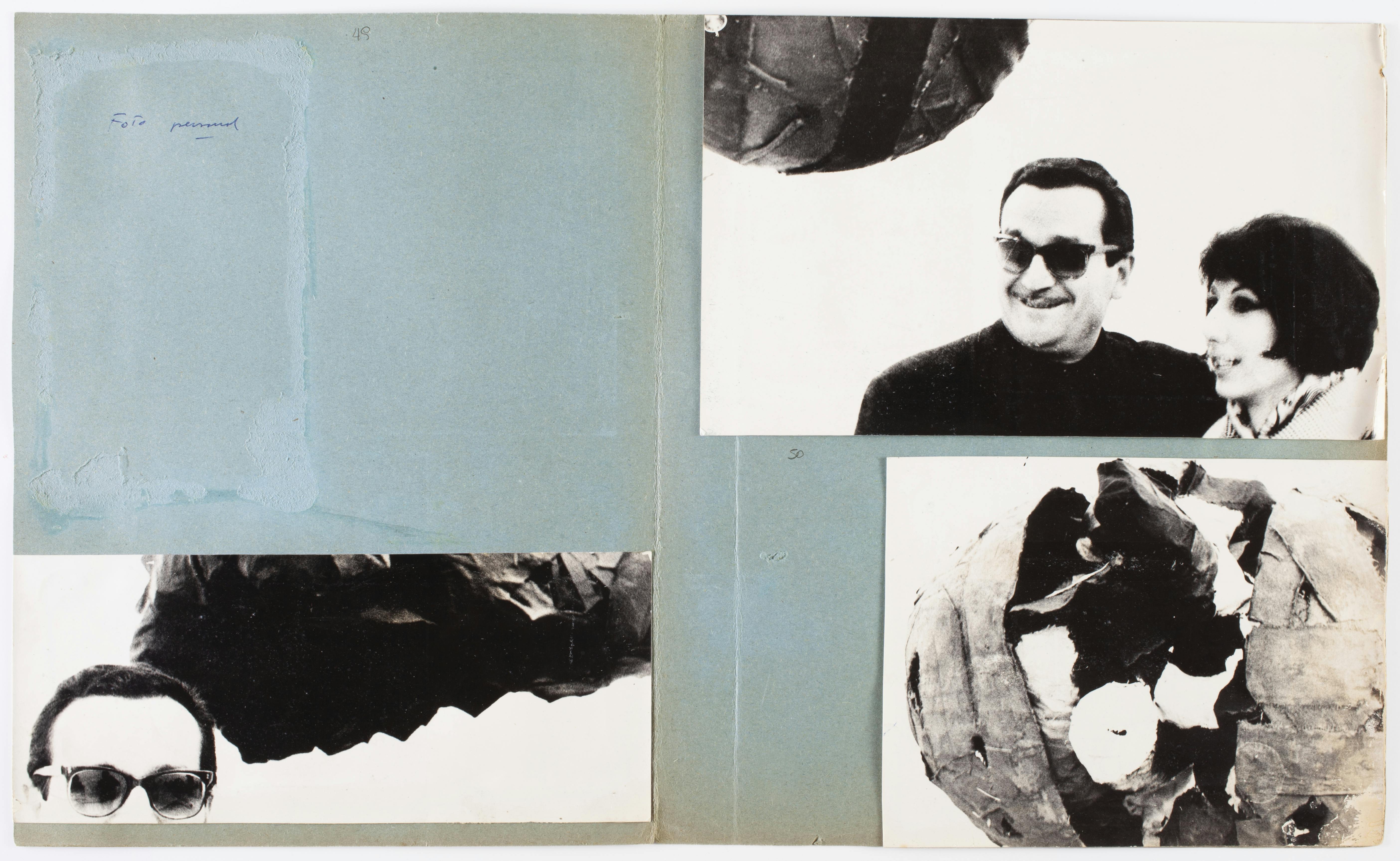
Photographs of Santantonín with his Cosas from his personal scrapbook. Undated. ISLAA Library and Archives
Rubén Santantonín: Hoy a mis mirones
CCS Bard
December 5–15, 2024
Bringing together materials from the Institute for Studies on Latin American Art (ISLAA) Library and Archives, Rubén Santantonín: Hoy a mis mirones is among the first exhibitions to focus on the Argentine artist Rubén Santantonín (1919–1969) since his passing.
The exhibition highlights the relationships between Santantonín’s life and work, including his photography and documentation of his practice, his writings on his vision for audience participation, and his collaborative projects—which together constitute his personal archive. Alongside these documents, a film by his friend and fellow artist Leopoldo Maler reveals Santantonín’s collaborative process and helps situate him within the context of Buenos Aires’s art scene of the 1960s. Santantonín’s meticulous editing, as reflected in his archive, guides the exhibition’s concept and structure and offers viewers the chance to engage in an intimate dialogue with the artist. “Cosas,” or “things,” were at the center of his practice throughout the 1960s—a period of widespread political instability and subversive artistic expression in Latin America. As a result, artists of the time strove to develop new forms and artistic languages to break from tradition.
Santantonín defined his Cosas—made from accessible, non-precious materials like plaster, cardboard, and wire, and often suspended from the ceiling—through what they were not: as the “Antithesis of Artwork,” the “Antithesis of Sculpture,” and the “Antithesis of Man.” Santantonín outlined his vision for audience participation with the Cosas in a 1961 artist statement titled “Hoy a mis mirones” (To My Gawking Spectators, Today):
"I want them to have a means of communication with those hanging things that reaffirm in me the idea of what I believe art is today: a participatory existential devotion, a devotion without peace or leisure."
According to some of his contemporaries, Santantonín grew increasingly isolated and frustrated by a lack of understanding toward his work. He destroyed his Cosas in 1966, just three years before his untimely death. Though the materials featured in this exhibition represent some of the only surviving traces of the Cosas, Santantonín’s archive reveals that he advocated for this work to be shown in museums up until his death. Through the revival of these and other materials, Rubén Santantonín: Hoy a mis mirones offers a long overdue exploration of Santantonín’s artistic ideas and his contributions to the history of art of the 1960s in Argentina and beyond.
Rubén Santantonín: Hoy a mis mirones is cocurated by Ray Camp, Hayoung Chung, Bruna Grinsztejn, Cicely Haggerty, Lekha Jandhyala, Ariana Kalliga, Sibia Sarangan, and Micaela Vindman, with generous guidance from professor and curator Mariano López Seoane. The exhibition and accompanying publication result from a graduate seminar at CCS Bard supported by ISLAA as part of the ISLAA Artist Seminar Initiative.
Opening Reception: Thursday, December 5, 5 PM–7 PM
The ISLAA Artist Seminar Initiative supports graduate seminars on key figures and periods of Latin American art with a focus on living artists who participate in conversations with students or on historical figures represented in the ISLAA collection. Students collaborate to produce a public-facing exhibition that aims to expand art historical narratives and provide a platform for emerging curators.
Rubén Santantonín (b. 1919; d. 1969) was an Argentinian visual artist. Although he was active in the Pop art movement through his participation in Torcuato di Tella Institute, Santantonín's personal artwork was based more on conceptual and abstract idealism. His artworks tended to involve mixed media that would challenge the viewer's relationship with objects and materials.


