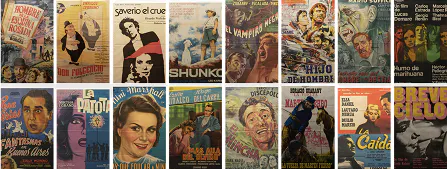
At ISLAA's Spotlight Galleries in Tribeca, Argentine Film Posters, 1940s to 1970s brings together sixteen posters selected from ISLAA's graphic design collection. Spanning four decades, they show how designers used portraits of stars, caricature, illustrated scenes, photography, and lettering to introduce films to audiences. Together, the posters reveal the visual choices that shaped the public image of Argentine cinema.
The selection ranges across comedy, football, literary adaptation, crime, horror, and melodrama. Raúl Manteola gives nearly the entire poster for Hay que educar a Niní (1940) to Niní Marshall's face. For Hombre de la esquina rosada (1962), adapted from a story by Jorge Luis Borges, Osvaldo Mario Venturi sets a large, angled title above a Buenos Aires street scene. Rafael Faillace organizes La patota (1960) around an enlarged eye, while Guillermo González Ruiz pairs oversized lettering with a photographic closeup in Breve cielo (1969).
These posters belong to ISLAA's broader collection of Latin American graphic design, assembled over more than three decades. The collection also includes works by Mary Vieira, Edgardo Giménez, Lorenzo Homar, Achille Mauzan, Almir Mavignier, and many others. This presentation connects to ISLAA's partnership with El Pampero Cine and its support for two new films. In El fantasma (2026), directors Ignacio Masllorens and David Lamelas use the premise of a fictional documentary commission to revisit Rubén Santantonín, Lamelas's mentor and collaborator, through surviving documents and interviews. Mariano Llinás's Biografía de Jorge Luis Borges (2026), produced by Laura Citarella, draws on the writer's papers, books, and places. Both films screened at festivals in Venice, San Sebastián, and New York this September 2026.