The history of experimental and avant‑garde music in Latin America was deeply shaped by two educational initiatives active in the 1960s, 1970s, and 1980s: the Centro de Altos Estudios Musicales (CLAEM), which run from 1962 to 1971, and the Cursos Latinoamericanos de Música Contemporánea, which took place in fifteen editions between 1971 and 1989. In this article I discuss how these two institutions were not only related and, in some ways, similar, but also represented opposing models of international education and exchange.
Years ago, when I began researching the Cursos Latinoamericanos de Música Contemporánea and the history of experimental music in South America, I encountered the acronym CLAMC. I was already familiar with CLAEM, so the similarity of the two names confused me momentarily. CLAMC and CLAEM? After decades of repressive dictatorships in Latin America, whose efforts erased many histories, making sense of these obscure names felt strangely appropriate. To avoid confusion, in this article I refer to CLAMC simply as “the Cursos”. I have been researching the Cursos for half a decade. I have visited the Fundación Archivo Aharonián Paraskevaídis (FAAP) in Montevideo and conducted extensive interviews with surviving participants. This is my first attempt to present my findings.
The Cursos cannot be fully understood without examining the history of CLAEM, just as a history of CLAEM would be incomplete without acknowledging the Cursos as both a consequence of and a response to CLAEM’s existence. This article offers a comparative analysis of the two initiatives. I begin with a brief introduction to each, followed by a focused discussion on three key aspects: funding and political orientation; educational model; and institutional status and location. Since CLAEM was based in Buenos Aires—and because this analysis connects the Cursos to it—my historical remarks will primarily center on Argentina and Uruguay, namely the Río de la Plata region. During the 1960s, Buenos Aires was a culturally vibrant and cosmopolitan city striving to align itself with major Western cultural centers 1 . The city’s history was shaped in part by successive waves of colonial and European immigration, especially in the twentieth century. While Argentina’s demographics vary greatly by region, the official culture of Buenos Aires has historically looked to Europe as a cultural model and enacted policies that erased and marginalized its indigenous and African legacies. 2
The international context of this period was shaped by the Cold War and the Cuban Revolution, both of which had profound effects on Latin America and the Caribbean. The 1960s and 1970s were marked by political turbulence, as authoritarian regimes became widespread across South America. Many of the region’s key events were influenced not only by these global tensions but also by the historical and ongoing intervention of the United States 3 . In the 1960s, the U.S. sought to reshape its relationship with Latin America through initiatives such as the Alliance for Progress, which aimed to promote modernization in the arts and sciences and to foster “political freedom through material progress.” 4 These initiatives often took the form of creating and funding cultural institutions. In Argentina, for instance, numerous cultural organizations were established during the presidency of Arturo Frondizi (1958–1962). This context is particularly relevant to one of our case studies: CLAEM, which exemplifies the type of institution supported under this broader cultural and political agenda.

Vista parcial del Fondo CLAMC en la FAAP. Fotografía de archivo que muestra materiales de los Cursos Latinoamericanos de Música Contemporánea (CLAMC) preservados en la FAAP. Cortesía Fundación Archivo Aharonián-Paraskevaídis.
The Centro Latinoamericano de Altos Estudios Musicales
Founded in 1958, the Instituto Torcuato Di Tella brought together centers for advanced scientific and artistic research under the direction of Enrique Oteiza and Guido Di Tella. Within this framework, the Centro Latinoamericano de Altos Estudios Musicales (CLAEM) 5 was established through efforts led by composer Alberto Ginastera, who had been in discussion with a Rockefeller Foundation official, John P. Harrison, about creating a graduate‑level program for Latin American composers. Ginastera and the institute's leadership believed regional composers lagged in compositional training. Ginastera argued that what prevailed among Latin American composers were “the concepts and techniques of old Italian band masters,” so CLAEM needed to recruit talented composers and to “update their technique and reinforce their basic knowledge." 6 Backed by Western funding, CLAEM aimed to modernize training—ultimately reinforcing a colonial model in which Latin American composers were expected to meet European and North American standards.
Between 1962 and 1971, fifty-four Latin American composers from different countries traveled to CLAEM to study contemporary music with a strong faculty of Argentine, European, and North American composers that included Gerardo Gandini, Francisco Kröpfl, Fernando von Reichenbach, Iannis Xenakis, Aaron Copland, Olivier Messiaen, Larry Austin, Bruno Maderna, Riccardo Malipiero, and Luigi Nono. 7 CLAEM had a profound impact on the region’s avant-garde, providing young composers with unprecedented resources and a platform to connect with the global scene and to foster international cultural relationships. 8
Although the Di Tella Institute was initially associated with Pop Art, modernity, and mass consumption, it ultimately became a hub for the emerging counterculture, artistic experimentation, and politically engaged art—perhaps precisely because of the growing urgency of the political situation. CLAEM’s high visibility within this context attracted the attention of the ultraconservative military dictatorship. Increasing political pressure, combined with the broader climate of conflict and the financial difficulties faced by the Di Tella family, led to CLAEM’s closure in 1971. 9
Los Cursos Latinoamericanos de Música Contemporánea
The consequences of CLAEM’s closure in the cultural life of the region, extended beyond the institutional itself. Throughout the 1970s, the political situation in Argentina and across Latin America grew increasingly unstable, fueling widespread distrust in state and institutional support. In this climate, the drive to build solidarity networks among Latin American composers—already present during CLAEM’s operation—intensified after its closure. 10 Some former fellows, with Coriún Aharonián, Raúl Das Neves, and Mariano Etkin as key organizers, moved toward creating an un-institutional, self-managed alternative to generate regional musical exchange: the Cursos.
The Cursos were a curated, itinerant series of courses that gathered composers and students from Latin America with North American and European guests to teach and study contemporary music (Luigi Nono, Helmut Lachenmann, Dieter Schnebel, and Gordon Mumma, to name a few). Their fifteen iterations took place in Argentina, Uruguay, Brazil, the Dominican Republic and Venezuela; their aim was to create an international space for the study and discussion of contemporary musical issues, with a strong emphasis on the situation of Latin American musicians and the socio-political and artistic contexts in which they lived and worked. 11 One hundred and fifty teachers from different countries were invited to participate without any compensation for their activities. The program had a pronounced ideological agenda and was conceived in opposition to the “hegemonic authoritarianism and sophisticated stardom of the Darmstadt international summer courses” and the imperialism of the United States. 12 Each iteration consisted of two weeks of intensive twelve‑hour workdays (or more) filled with lectures, concerts, listening sessions, and communal meals.
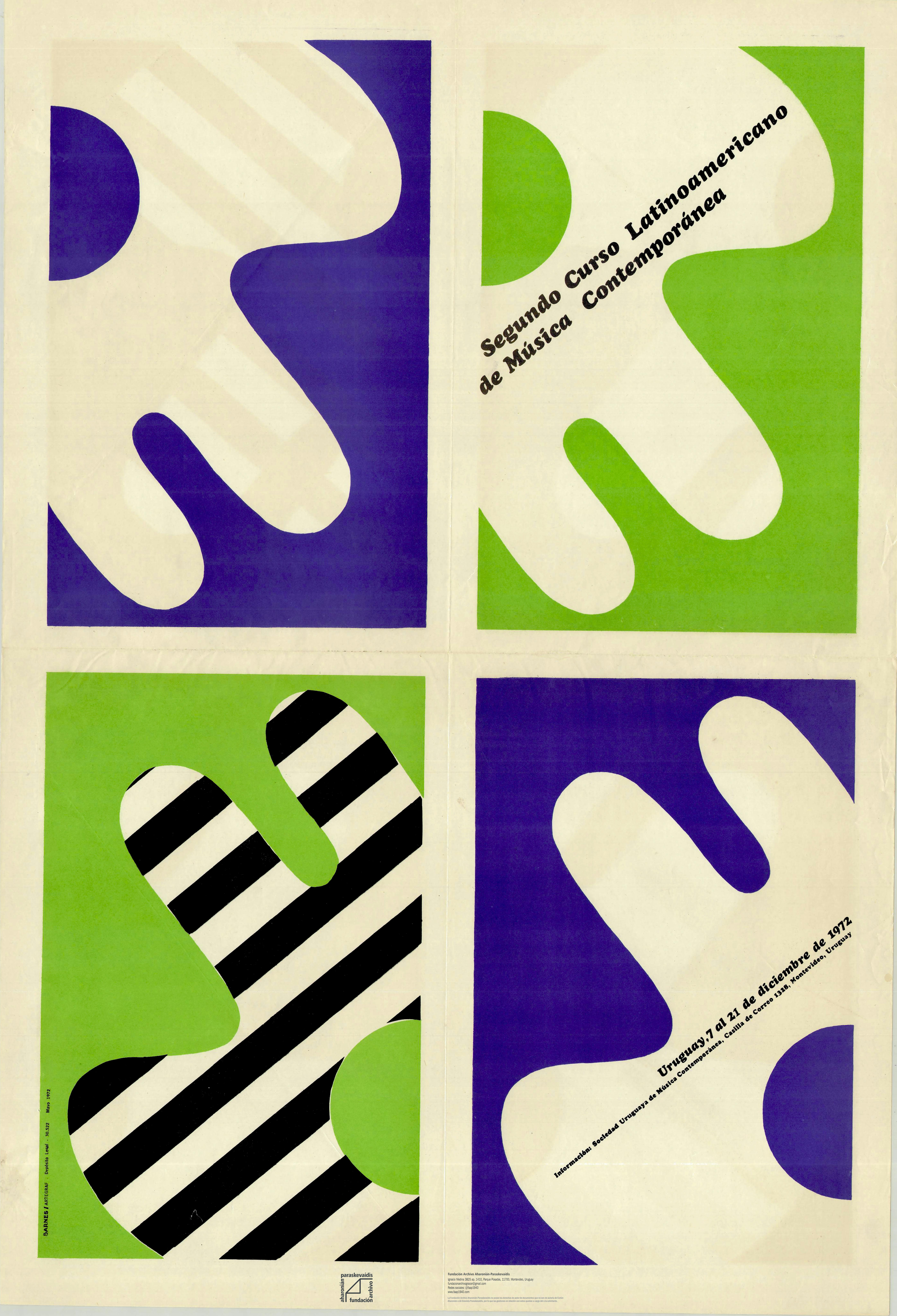
Póster promocional del Segundo Curso Latinoamericanos de Música Contemporánea (1972). Cortesía Fundación Archivo Aharonián-Paraskevaídis.
Comparative analysis
I call this article “Preliminary Findings” because as my research about the Cursos progresses, I realize that several characteristics allow for a comparative analysis with CLAEM. I will focus on three aspects to illustrate this: funding strategy and political orientation, educational model, and institutional and nomadic character.
As noted by art historian Andrea Giunta, after the Cuban Revolution and the Alliance for Progress, Latin America became a priority for the United States in terms of cultural intervention. 13 For many scholars and intellectuals, the Alliance for Progress is understood not only as an economic initiative but also as a cultural strategy aimed at curbing the spread of communism in the region. CLAEM, funded by the Rockefeller Foundation, serves as a clear example of this strategy. Its emphasis on modernization and the production of accessible, consumable art aligned closely with U.S. capitalist interests. As the 1960s progressed and U.S. political involvement in Latin America deepened, such cultural interventions—often facilitated through funding and the promotion of specific artistic agendas—came under increasing scrutiny and criticism. The Cursos were a reaction to these neocolonial cultural models. How could one generate an international exchange platform that would be independent from the centers of power? The answer the organizers found was to make the Cursos self-financed. Activities were primarily funded through student contributions to cover basic needs like food and accommodation, with partial support from institutions such as the Goethe-Institut and other international and state organizations that covered specific expenses—particularly those related to international guests.
The professors who attended the Cursos understood their involvement as an act of resistance to Latin American dictatorships. In Paraskevaídis’ words, “they were willing to contribute to the struggle,” working for free, teaching classes, and performing in exchange for food and accommodation. 14 In a video interview, Conrado Jorge Silva de Marco, who was involved in the Cursos early on, says, “we did something that was never done before which is to invite composers and say that we wouldn’t give them any fees, and it went relatively well”. 15 Furthermore, some international teachers, like Luigi Nono or Gordon Mumma, had a marked leftist ideological agenda so there was mutual urgency to address how cultural life could contribute to fighting colonialism—mostly based in Guevarista concepts that “a new man needs a new culture”. For example, in correspondence between the Cursos’ organizing team and Morton Feldman and John Cage, we see how the “militant” character of the Cursos was explicit and, in a way, expected. The invitation letters state:
Our purpose is to give the course the highest teaching level, satisfying in this way the urgent needs of composers and performers in this part of the world. That’s why we have the pleasure to invite you to integrate the teachers’ group of this first course. Our society will have the responsibility of the sojourn expenses during the course. It will be impossible for us to pay for the travel and the eventual “cachet”. We have consequently sent a letter to the Cultural Attache of the US Embassy in Uruguay, asking him about the possibility of charging these fees to the US government. 16
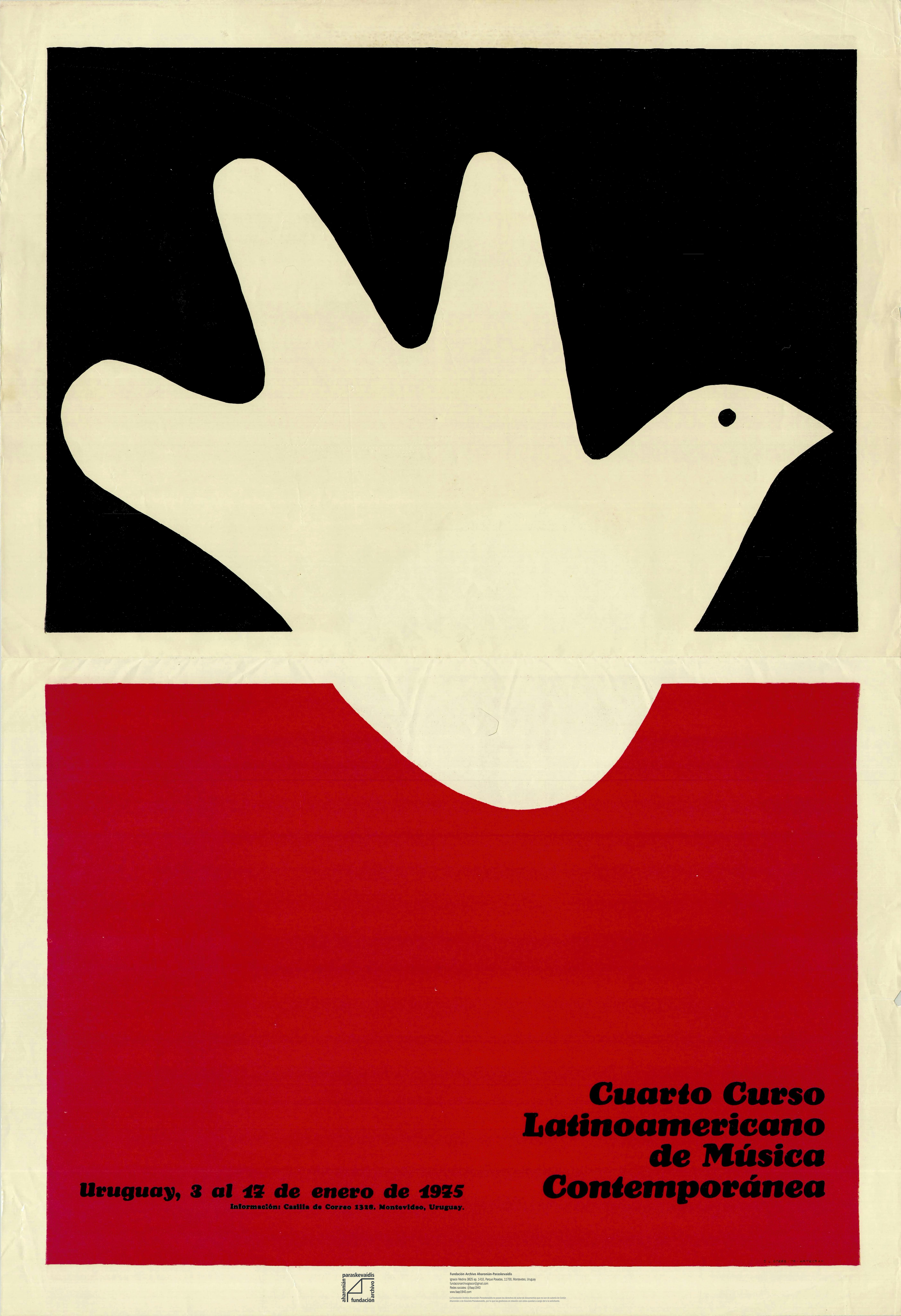
Póster promocional del Segundo Curso Latinoamericano de Música Contemporánea (1975). Cortesía Fundación Archivo Aharonián-Paraskevaídis.
The negotiation to bring Feldman to the Cursos never worked out because external funding was not found to cover the $1,000 fee he requested. On the other hand, Cage wrote in his response that he was trying to devote all his time to his work. Aharonián and Héctor Tossar wrote back to him: “As to the time for your work, you’ll have enough of it, in a pleasant atmosphere with woods, hills and beaches. And some guerrilla noises, of course.” 17 In a climate of ideological and political persecution and by evading the institutional realm, the Cursos consolidated as a pseudo-safe space to share anti‑colonial commitments and leftist ideologies. This was not done naively; the workshops themselves were spaces to question what militancy meant for people in different global contexts.
The second aspect I will discuss is how the Cursos differed from CLAEM as an educational project. As stated before, CLAEM was modeled after European and North American institutions (the Darmstadt Summer Courses, the Warsaw Autumn and Donaueschingen festivals and the Columbia Princeton Electronic Music Center, among others). Ginastera’s criticism of Latin American composers, comparing them to “Italian band masters,” clarifies his idea of where the cultural North was for him. Italian band masters are associated with popular music as opposed to the elitist conception of music as an elevated art for a few. CLAEM’s objective was to insert Latin American composers into the European and North American world by aligning with global trends and elitist metropolitan cultural models.
In direct contrast, Aharonián’s central form of resistance to neocolonialism lay in his rejection of imported cultural models 18 . He conceived musical education in Latin America as a historical continuum beginning with the Spanish conquest. According to Aharonián, musical education functioned as an instrument of colonial domination—designed to ensure cultural subordination and to reinforce political and economic dependency. 19 . From his perspective, the continued Eurocentrism that permeates musical education in the region was a critical issue demanding urgent attention.
In a manuscript note titled "Things to consider if we ever plan to do a new music course," Aharonián outlined ideas intended to distinguish the Cursos from traditional educational models. 20 Among other proposals, he suggested implementing auditions to assess participants’ levels—while explicitly rejecting the recommendation-based system used at CLAEM. For Aharonián, the ethical and democratic integrity of the selection process was essential. In the same document he wrote: “Ensure that the course does not take on a ‘lecture-style’ character. Let the seminars truly be seminars. No apostles, gods, or dictators.” The aim of the Cursos was to foster genuine horizontal exchange among all participants. In the letter in which John Cage declined the invitation to teach at the Cursos, he wrote with his characteristic humility: “We are all students and teachers; therefore, I don’t teach.” The organizing team then playfully invites him to join as a student: “You still have time!” With sharp wit, they subtly critique the rigid hierarchies often found in European-style educational systems, inviting Cage to step outside that model. Ultimately, Cage never attended the Cursos. 21
In the opening discourse of the tenth session of the Cursos, Aharonian stated:
Because in Latin America there is difficulty in obtaining information in order to train oneself [...] there is difficulty in accessing high-level teachers or simply the right level [...] there is difficulty in maintaining institutionalized structures [...] it is impossible to afford financially expensive solutions [...] this solution has been reached, which could be described as cultural militancy, in which teachers and organizers work for free, as a way of contributing to the training of young Latin American musicians and thus participating with some grains of sand in the historical process of our mestizo continent.
Latin America is a colonial territory. One of the manifestations of colonialism is the castration of every potential creator. To ensure the political-economic hegemony of the imperial metropolis, it is necessary that cultural models be exclusively produced or at least controlled by the metropolitan masters of power. The possibility of the existence of full creators in colonial territories would mean the possibility of generating autonomous and own cultural counter-models, and this is extremely dangerous. For the metropolis, of course. Not for people who want to be free. 22
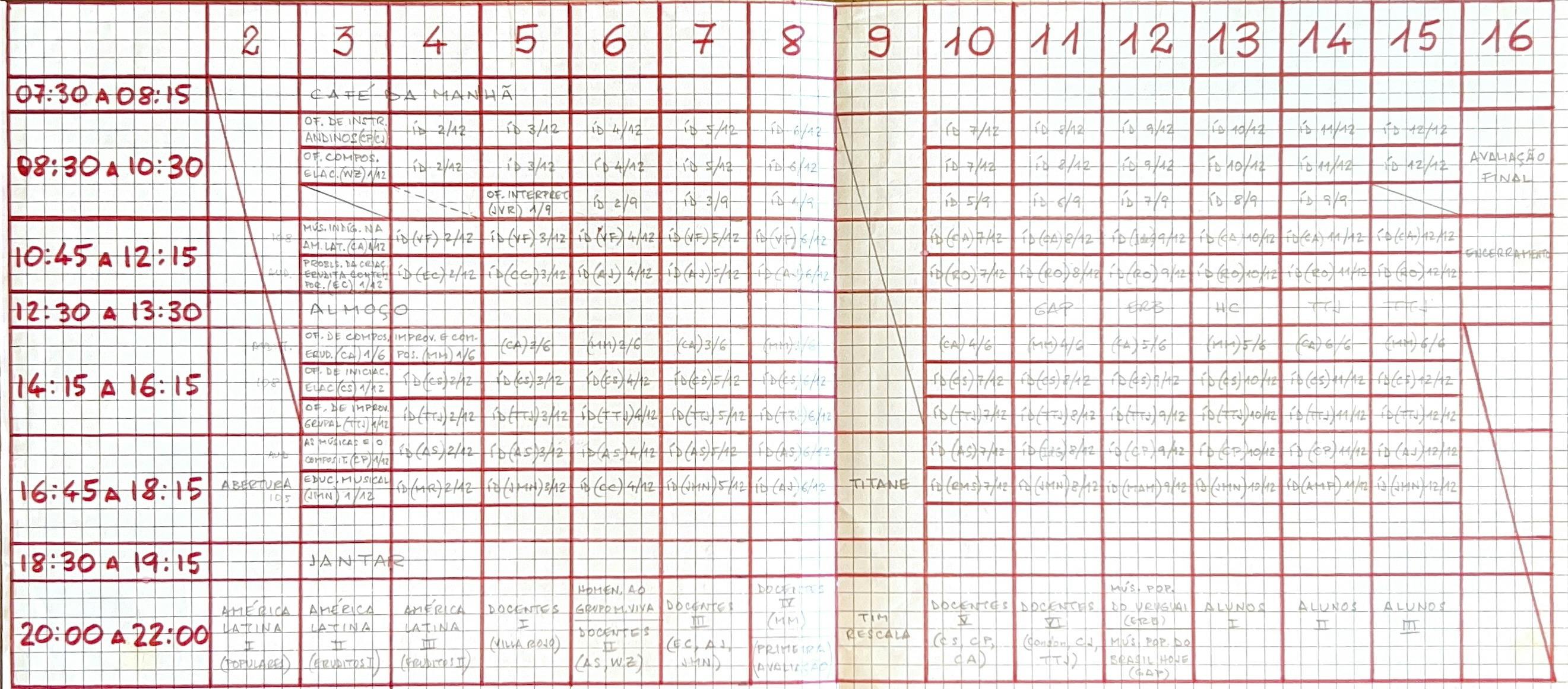
Cartelera cronológica del XV Curso Latinoamericano de Música Contemporánea (CLAMC). Cortesía Fundación Archivo Aharonián-Paraskevaídis. Año 1989.
It is interesting to consider how Aharonián and his contemporaries grappled with the paradox of being composers of “erudite” or academically informed music within the Latin American context. 23 For Aharonián, the complex identity of Latin America—as a hybrid of Indigenous, African, and European cultural elements—demanded not only acknowledgment but active engagement and reflection within the act of composition. As Herrera notes, Aharonián did not seek to abandon the European musical tradition. Rather, he aimed to reinterpret and appropriate it from a peripheral standpoint, using it to generate a critical and destabilizing response. This decolonial approach—conscious of Latin America's colonial past and neocolonial present—was central not only to his philosophical outlook but also to the pedagogical design of the Cursos. His militant call to action was not directed at centers of global cultural power but instead addressed the internalized structures of oppression perpetuated by neocolonial subjects. For Aharonián, Latin American creators carried a responsibility: through their artistic choices they either contributed to or resisted the persistence of dependency and oppression. 24 He advocated a process of self-critique, self-reflection, and heightened awareness. As Omar Corrado writes, the Cursos embodied this dual purpose: on the one hand, they offered participants up-to-date information about contemporary international musical developments; on the other, they promoted a critical assessment of that knowledge in relation to the lived histories, cultural dynamics, and artistic practices of Latin American musicians 25 .
It is important to note the multiple, overlapping colonial, metropolitan, and imperial systems at play when analyzing the Cursos. First, there is the legacy of the Spanish conquest, followed by the broader European (Portuguese and later British) imposition of epistemological and economic domination over the conquered peoples of the Americas from the end of the fifteenth century onward. This historical foundation intersects with internal tensions within Latin America itself—particularly between rural and Indigenous populations and major metropolitan centers such as Buenos Aires and Montevideo, which have long been shaped by European cultural influence. In addition, there is the neocolonial U.S. imperialism with its economic and political influence in the region. Lastly, cultural colonization—emanating from global centers like New York, Paris, and London, and regionally from Buenos Aires during that period—reinforced hegemonic aesthetic values and artistic norms. These layered dynamics must be considered to fully understand the cultural and political forces surrounding the Cursos. 26 .
Finally, I will address the differences between CLAEM and the Cursos in terms of institutionality and resources. As described above, CLAEM was funded as an organization with a fixed location, a private building, and an electronic music studio, with the aim of creating an educational entity that would have international institutional weight.
In contrast, the Cursos were conceived as an action or a practice rather than as an entity or institution. The Cursos were itinerant. The organizing committee would choose an accessible, relatively non-touristic location where attendees could focus on the intensive activities without being distracted by tourism. The itinerant format permitted a wide range of students that varied depending on where the Cursos took place. From the student lists one can see how Brazilian participation increased when activities were held in Brazil; Puerto Rican attendance rose when workshops ocurred in the Dominican Republic; and Argentine participants congregated at the edition in Cerro del Toro in Uruguay. This itinerant strategy reflects Aharonián’s understanding of the importance of regional communication and cultural decentralization. Similarly, the Cursos ocurred in neighboring countries with different languages, attempting to foster regional language understanding and familiarity.
Regarding resources, as Eduardo Herrera notes, CLAEM included the best-equipped electroacoustic music studio in the region, called the Laboratorio de Música Electrónica. 27 Access to this studio was one of CLAEM’s most significant advantages. The Cursos also treated electronic and electroacoustic music as an important genre. Without a fixed location and funding, the equipment needed for concerts, lectures and specific electronic workshops had to be sourced for each iteration. In the FAAP archive there is extensive correspondence among the Cursos’ organizers, professors and performers about how to make things happen with minimal resources. Equipment was sourced, borrowed, lent, or brought by participants in in all kinds of collaborative efforts.
Ultimately, in my view, the nomadic and decentralized quality of the Cursos was a survival strategy. In a climate of political persecution, their design allowed for less visibility and greater flexibility to dissolve as an entity if necessary. The organization was conceived as a network with multiple people in charge of decision‑making so the mission could continue even if one member disappeared. It is worth noting that this strategy reflected broader patterns of organized resistance in the region. Several guerrilla and revolutionary groups opposing the dictatorships employed similar nomadic organizational tactics: they kept their location unknown, different cells would emerge here and there unexpectedly, and the armed groups were decentralized and seemingly undefined for outside observers. Opacity, multiplicity, and decentralization were thus deployed as decolonial tools in the governance of the Cursos.
As this brief analysis suggests, CLAEM and the Cursos were in many ways more different than similar, yet, they remain inextricably linked—two distinct but interconnected chapters in the history of experimental Latin American music. CLAEM was crucial in educating composers and providing them with resources and international connections that shaped a generation. Ironically, one of CLAEM’s founding goals was to counter the threat of socialism in the region. As discussed above, that objective ultimately backfired: several participants emerged from CLAEM not with a stronger identification with cosmopolitan cultural centers but with increased political awareness and a commitment to regional self-determination.
In this regard, the Cursos appear remarkably ahead of their time. They embodied a decolonial approach to contemporary and avant-garde music—both in terms of creative practice and musical education—long before such frameworks gained broader academic recognition. Through CLAEM and the Cursos, one or two generations of Latin American composers and artists received formative training that shaped the region’s musical trajectory in lasting ways. This text represents an initial attempt to generate a framework for understanding the complex contradictions that this history encompasses.